A small area (< half acre) will be marked with posts, flags, string/tape. Within the marked site, participants will walk around the boundary and describe the five following .
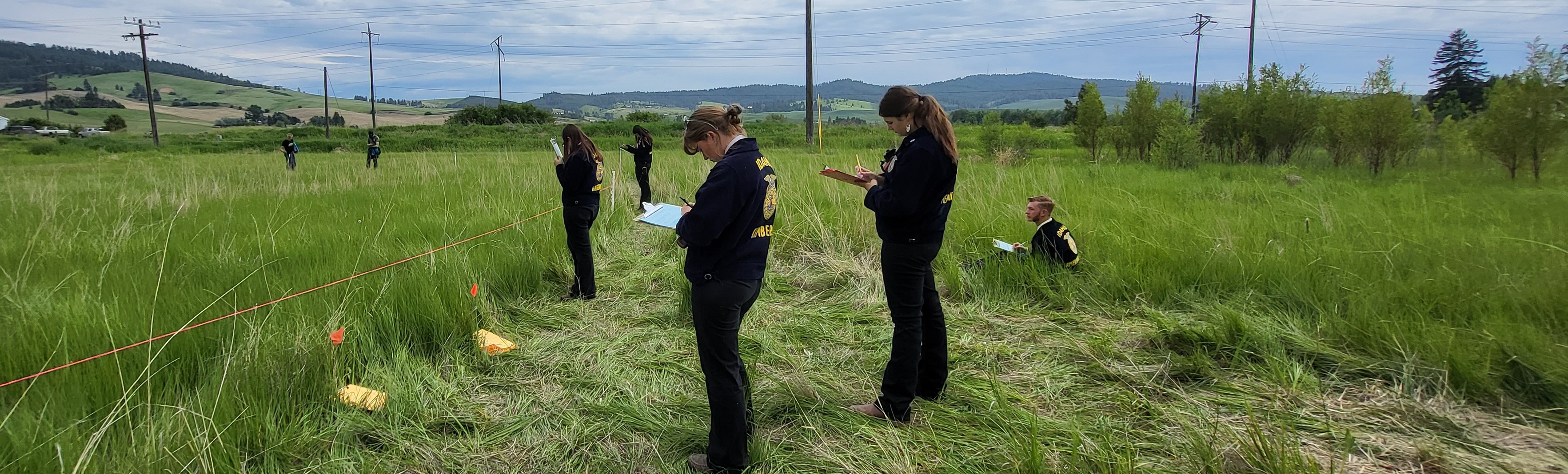
1. Identify and list as many organisms (both native and invader) that can be found within the marked borders of this site. (20 pts)
Participants will identify and list as many living organisms (both native and introduced) as they can find within the marked boundaries of the site.
- List at least 4 organisms or life forms on the site (8 pts).
- Increasing points for variety of life forms (12-15 pts).
- Specific plants or animals (1-20 pts).
Many participants come from parts of the state that are quite different than the Moscow area, below are links to some helpful resources to study the local plants of the Palouse Region in northern Idaho:
>> Idaho Native Plant Society (White Pine Chapter)
>> Field Guide to Forest Plants of Northern Idaho
2. Identify and list all non-living components found within the marked borders of this site. (20 pts)
Participants will inventory resources such as water, shelter, etc. upon which resident species depend for survival.
- List at least 5 non-living components (10 pts).
- Then, increasing points for variety and specificity (12-15 pts).
- Specific location, type, or amount (i.e., not just rocks, but rocky outcrop on south side of the site (16-20 pts).
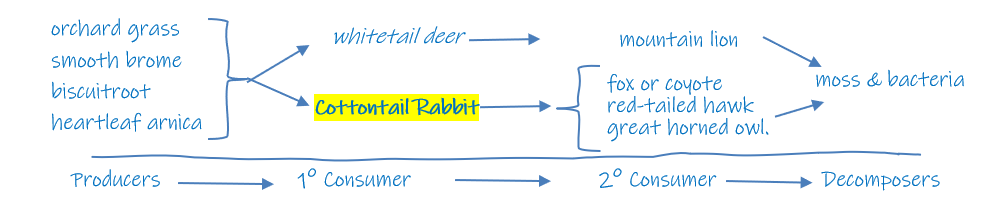
3. Describe the food web presented in the marked ecosystem. (20 pts)
Participants will define relationships among the plant and animal species that are found or introduced in the study area.
A plant or animal will be designated at the site with a labeled picture or taxidermy specimen as the organism to build a food web around. Listed below are examples, representing increasing points, for food chains and webs including a Cottontail Rabbit as the featured organism.
- Basic Food Chain – including producer, several levels of consumer, and decomposer (0-5 points)

- Food Chain – parts labeled as producer, consumer, etc (6-12 points)

- Food Web – increasing points within increasing specificity (13-20 pts)
4. Identify the stages of succession of various grasses, shrubs and trees.(20 pts)
Participant should first consider what the “late seral” stage of the site might be: a prairie, forest, shrubland, or riparian zone around a stream or wetlands.
- Mention what final seral state (i.e., climax state or “potential natural community) would be expected on the site (i.e., grassland, shrubland, forest). (1-5 pts)
- Discuss plant community as relates to current seral sage (6-20 pts)
- Higher scores for discussion specific growth forms or specific plants
- If low seral stage is suggested, this should include mostly annual plants with little diversity
- Mid-seral would include major growth forms (i.e., grasses, shrubs, or trees) expected to occur in the potential natural communities. However, sites may be dominated by non-native plants, have limited diversity, or have a few species that dominate the site.
- Late-seral sages would be close to potential natural community. Mostly native plants with a variety of growth forms and no single species dominating the site.
Participant should first consider what the “late seral” stage of the site might be: a prairie, shrubland forest, or riparian zone around a stream or wetlands. Once the potential natural community (or Climax) of the site is determined participants should look for type of plants that indicate where the plant community is along a seral continuum (early, mid, or late). Listed below are indicators of seral states for various grassland, shrubland, or forest potential natural communities in northern Idaho.
PRAIRIE SITES (Grassland Climax) – Found on the rolling loess hills of the western edge of Northern Idaho, these highly productive sites are maintained by long summer dry periods and occasional fire.
- Early Seral: Highly disturbed sites are dominated by invasive annual grass monocultures like cheatgrass, and annual or weedy forbs like mustards, prickly lettuce, whitetop. Very few native plants or deep-rooted perennial grasses.
- Mid Seral: Few native perennial grasses or forbs. Plants are deep-rooted introduced grasses like intermediate wheatgrass, smooth brome, or meadow foxtail and a mix of native and introduced forbs that are not highly invasive. These forbs may include western yarrow, salsify, biscuitroot or a few annual mustards. No overstory of trees, though a few shrubs may be present.
- Late Seral / Climax: A diverse, rich bunchgrass community with mostly native grasses including bluebunch wheatgrass or Idaho fescue on drier sites. Very high-quality sites would include native forbs like arrowleaf balsamroot, lupine, yarrow, or biscuitroot.
UPLAND SHRUB SITE (Shrub Climax) – Often occurring on steep, rocky, or uncultivated hillsides where soils are too shallow or dry for trees, but moisture is sufficient to support a dense woody understory.
- Early Seral: Generally occurring after a wildfire has removed the shrub overstory. The community is dominated by annual grasses like cheatgrass or pioneering perennial grasses like tall oatgrass. Several weedy forbs like prickly lettuce or salsify are present and perhaps a few sprouting like snowberry .
- Mid Seral: In this stage woody plants are abundant, but patches of grasses or forbs are also present. Shrubs include a mix of mostly native shrubs with ninebark and serviceberry on drier south-facing slopes and chokecherry, hawthorn, or elderberry on more most mesic sites.
- Late Seral: A dense, nearly impenetrable thicket dominated by mature ninebark (often growing in close association with ocean-spray, serviceberry, and a variety of other shrubs. Only a few small grass-dominated patches exist. A variety of shade-tolerant native fobs like heartleaf arnica and waterleaf occur.
ASPEN, BIRCH, MAPLE (Deciduous Forest Climax) – Quaking aspen, paper birch or Rocky Mountain Maple are examples of deciduous trees that frequently act as a long-lived mid-seral community on moist forest sites, but they can achieve a stable climax state on specific areas where slope or soil conditions restrict conifer establishment.
- Early Seral: Fires or cutting can remove the overstory and stimulate root suckering. This stage features incredibly dense, uniform stands of young aspen saplings alongside fire-following forbs like fireweed or lupine and native bunchgrassess. Sunlight directly hits the forest floor and some areas of bare soil occur.
- Mid Seral: An open-canopy forest has become established, but the understory consists of non-native grasses such as smooth brome or orchardgrass and forbs including lupines, groudsels (senecio), and western yarrow. This mid-seral stage can be productive and stable but lacks the diversity of native plants that would occur in the late seral stage.
- Late Seral: An open-canopy forest of mature, multi-aged tree stands. Because the canopy remains relatively open compared to conifer forests, the understory is lush, highly diverse, and dominated by tall native forbs, like cow parsnip or wild geranium, and native grasses such as mountain brome.
EVERGREEN PINE and FIR (Conifer Forest Climax) – These evergreen forest types represents the classic moisture gradient transition of the Northern Idaho forest zones, from drier Ponderosa pine into Douglas fir. Western Larch or Western redcedar habitat types.
- Early Seral: Following a stand-replacing fire or clearcut, the community is initially dominated by light-demanding, fast-growing pines and firs. The stand structure is open, with a vigorous shrub including snowberry and ninebark in the understory. Herbaceous plants like fireweed and pinegrass that often sprout after fire may also occur.
- Mid Seral: At this developing stage all the trees that will appear in the late seral stage are present but immature. Other understory plants are present though many my be introduced and a few species may dominate which reduced biodiversity.
- Late Seral / Climax: A highly stratified, closed-canopy forest dominated by shade-tolerant species. The forest floor is dark, humid, and heavily moss-covered, with few understory forbs or shrubs.
RIPARIAN SITE (Wetland/Hydric Climax) – The streams and rivers of Northern Idaho are framed by diverse woody riparian communities capable of growing in wet soils and frequent water-driven disturbance.
- Early Seral: Riparian areas that are degraded will show severe signs of disturbance after a heavy flood. This will include cut banks and gravel or sandbars that are not well vegetated. A lack of mature shrubs, a lack of diversity of grasses, and forbs that are mostly annual or invasive.
- Mid Seral: A shrubby overstory of alder, cottonwood, or hawthorn are present but are mostly young or old with little age diversity. Smaller trees or understory shrubs such as redosier dogwood, coyote willow, chokecherry and serviceberry are present but appear to be primarily young or old and decadent. The understory plants are primarily weedy forbs and grasses with little diversity.
- Late Seral: A highly stable, structurally complex of large riparian trees (alder and cottonwood) and/or stands of dense and diverse riparian shrubs. A good age structure is present with a mix of young and mature plants. A dense stabilizing understory of deep-rooted, rhizomatous wetland sedges, rushes, grasses, and forbs are present. The mix of trees, shrubs, and herbaceous plants show evidence of good bank stabilization.
5. Determine whether a healthy balance exists and recommend remediation where needed. (20 pts)
Participants will determine whether a healthy balance exists between the environment and the native species that depend upon it. They will also check remediation practices where needed.
- Discussion of healthy balance (12 pts) – Examples of points to indicate a healthy balance such as:
- Consider buildup of litter
- Existence of bare ground
- Discuss level or lack of erosion
- Presence or absence of noxious weed invasion
- Evidence of excessive grazing by wildlife or livestock (trampled vegetation or hedging)
- Describe sings of disturbance
- Variety of age structure among plants including young and old plant
- Recommendation of remediation (8 pts). – Examples of recommendation for remediation such as:
- Introduce plants that are missing (for example native forbs or shrubs).
- Reduce competition of grasses by grazing.
- Prescribed fire or shrub removal with saws or clippers (i.e., mechanical control).
- Reduce invasive plants or noxious weeds with weed control methods (i.e., herbicides).
- Stabilize stream banks.

 Idaho Environmental and Natural Resource CDE